
The System Design Decisions That Kill Startups at Scale
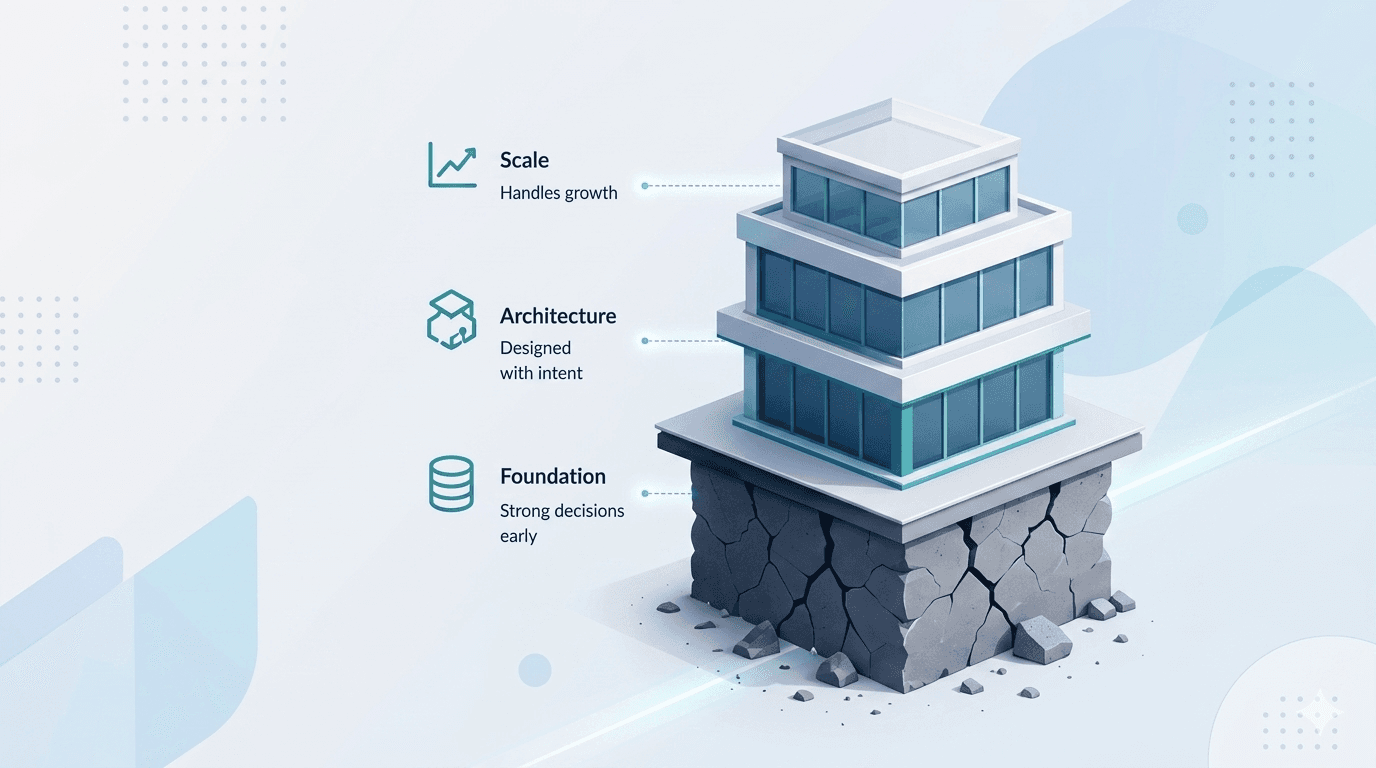
The architecture you choose in week one will either set you free or haunt you at 100,000 users. Here's what to get right before you write a line of code.
Most early-stage startups don't die from bad marketing or wrong pricing. They die because their architecture can't survive their own success — and the cost of fixing it mid-traction is catastrophic.
By the time you hit real user volume, the wrong decisions are already load-bearing. You can't swap them out without stopping the business. So let's talk about the three that matter most, and how to get them right before you write a line of code.
The Data Model You Design Today Will Be the One You Regret at 10 Million Rows
Your database schema is the most consequential thing you'll design in week one. It touches everything: how fast your queries run, how hard your features are to build, how painful your migrations become.
The most common mistake is designing for correctness in theory rather than for your real query patterns. Over-normalising data that gets read together creates joins that hurt at scale. Under-modelling relationships that become core features forces painful backfills later.
Design for the 10× version of your business, not where you are today. Ask what data you'll query together, what reports matter to your business, and what fields will need to be indexed at volume. That conversation takes an afternoon. Skipping it costs months.
The schema you ship in your MVP is the one you'll be migrating around 18 months from now. Most teams don't take it seriously until it's too late.
Service Boundaries: Why Microservices at Launch Is Almost Always Wrong
This one is misunderstood badly by founders who've read too many AWS blog posts. Microservices are an organisational scaling solution — not an architectural starting point.
A well-structured monolith with clean internal module boundaries is faster to build, easier to debug, dramatically cheaper to run, and trivially decomposable later when you actually have a team large enough to justify it. The teams that start with microservices early spend the first two months wiring services together instead of shipping product.
The right call: build a modular monolith with clearly enforced domain boundaries. When a specific service has distinct scale requirements — say, your notification system or file processing pipeline — extract it then. That decision belongs at Series A, not pre-launch.
Authentication Architecture: The Thing Nobody Gets Right the First Time
Auth is where startups hurt themselves most quietly. A basic username/password setup that works for 1,000 users becomes a nightmare when you need SSO for enterprise clients, multi-tenancy for team accounts, or granular RBAC for different user roles.
The right approach isn't to over-engineer from day one — it's to choose infrastructure that gives you room to grow without a full rebuild. That means using a well-scoped auth provider, structuring your permission model around roles from the start, and never hardcoding org-level logic into user tables.
If you're building a B2B product and your auth can't support organisations, workspaces, or team invites without a rewrite, you've already created a ceiling on your enterprise motion.
What Founders Should Actually Do About This
You don't need to be a systems architect. You need someone on your team who is — or access to one before the decisions get made.
Before you write the first line of code, ask your engineering partner: how does this hold up at 10× our current load? How do we add multi-tenancy later? What does a DB migration look like at 5 million rows? If the answer is vague or defensive, that's important signal.
The startups we work with at Malvora don't all get these decisions perfect. But they get them in front of the right thinking early, which is usually enough.
If you're pre-build or mid-build and not confident in your architecture decisions, book a free 30-minute strategy call. We'll review what you're planning, flag the decisions that will hurt you at scale, and tell you what to do differently — before it's expensive to change.
Every insight on this page comes from building real products with real founders. If something here resonates with a challenge you're facing, it's probably worth a 30-minute conversation.
Ready to build?
Build your MVP in 2–4 weeks.
Turn this insight into action. Book a free 30-minute strategy call and leave with a clear scope, architecture plan, and timeline.
